When one encounters challenges when passing bowel, an opening known as Stoma is made on the abdomen. The main aim of this opening is to divert waste through your abdomen rather than through the normal outlet, which is the digestive system. Stomas are usually used when the bladder or the bowel has been surgically removed or requires some form of healing.
The process of creating a Stoma usually involves the pulling of a part of your intestines onto the surface or close to your abdomen. An opening is then made on the intestines, which are attached to your abdomen. It is also of the essence to bear in mind that ostomies can be temporary or permanent. A permanent ostomy is surgically used when there is a permanently damaged organ in your digestive system. On the other hand, a temporary ostomy is surgically prepared when a part of your intestine needs to heal after a surgical procedure.
There has been a contentious debate on whether there exist any similarities between ostomy and Stoma. Regardless of this, these two terms are different and have different meanings. For instance, while an ostomy refers to the opening made on your abdomen, a Stoma is the end of the intestines (small or large) that is surgically sewn into the ostomy.
Types of Stoma
There are different types of Stoma, namely colostomy, urostomy, and ileostomy. In an ileostomy, a Stoma is created on your small intestines to allow waste to bypass your rectum and colon.
An ileostomy is a common procedure done on patients with ulcerative colitis, bowel cancer, or Crohn’s disease. On the other hand, in urostomy, a small pouch is made using your small intestines and connected to your ureter. The pouch allows your urine to drain outside of your body without passing through the bladder. Urostomy is common in instances where the patient has a damaged bladder. Finally, a colostomy procedure is common in patients with colon injury, blocked colon, or rectal cancer. The colostomy procedure usually involves the creation of a stoma on your large intestines, with the primary goal being to bypass the rectum.
Methods Used to Create Stomas
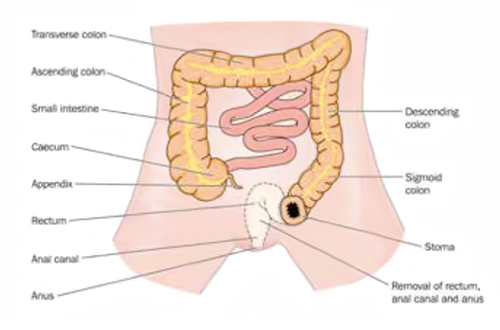
The aforementioned stomas can be created in two ways, namely loop ostomy and end ostomy. In end ostomy, the cut is made near the end of your intestines, pulled through the ostomy, and surgically sewn to the opening. On the other hand, loop ostomy is achieved when an intestine loop is pulled through an opening on the intestine and then cut on both ends. One Stoma is designed to allow mucus to pass while the other is meant for bowel movement. Like most surgical procedures, Stomas are designed under anesthesia.
Stoma Care
The type of care taken on a Stoma is determined by the type of pouch applied. Regardless of this, it is advisable to change the pouch every three to seven days. The pouch should also be emptied before its contents are one-third full. It is also advisable to clean the skin around the Stoma with warm water. Any form of irritation, pus, or redness should be reported to the doctor with immediate effect.

Complications Associated with Stoma Surgeries
Some of the “side effects” associated with stoma surgical procedures include skin irritation, dehydration, leakage, bowel obstruction, retraction, and parastomal hernia. Regardless of this, normal life resumes as soon as the Stoma heals.
 Ostomy Basics